
Microsoft users#
Overview#
You will need to onboard Microsoft users in Automate.
Onboarding a Microsoft user involves importing users and related data to the customer level from the Microsoft Cloud service, and then moving users to the correct sites as fully provisioned users.
Automated workflows configure imported objects once changes are synced in, and apply the required configuration, policies, and licenses. This means administrators won’t need to continually monitor the sync, or to perform additional steps to complete the process.
Once synced in (at the customer or site level), administrators can manage Microsoft users via a single interface and login, from within the Automate Admin Portal. To maintain data integrity, to manage licenses, and to automate number auditing for synced in users, regular, targeted backend syncs poll for changes made at the device model layer.
Note
If Enable Microsoft User License Enforcement is set to Yes in the Global Settings, a user can only be added if the license allocation limit for the user’s hierarchy is not exceeded. For details, see Microsoft License Management and Alerting in the Core Feature Guide.
Related topics
View and edit Microsoft users#
View a summary list of all Microsoft users#
This procedure displays a summary list of Microsoft users.
Log in to the Automate Admin Portal.
Choose the hierarchy.
Go to the Microsoft User Details page.
View a summary of Microsoft users at the current hierarchy.
The list view for Microsoft users provides details for the following, for each user in the list:
User principal name, first name, and last name
Licenses
Department
City, country, phone number, location
Associated device
View and update a Microsoft user#
This procedure displays and edits the details of a single Microsoft user.
Note
This workflow is intended for Microsoft-only users. When choosing a hybrid user with Cisco-Microsoft services, you’ll need to work with this user via the Hybrid multi vendor actions. The Hybrid Status Message field displays the user’s hybrid status. See Hybrid Cisco-Microsoft management
Log in to the Automate Admin Portal.
Choose the hierarchy.
Go to the Microsoft User Details page.
View a summary of Microsoft users at the current hierarchy.
Click on a user in the list to open their settings.
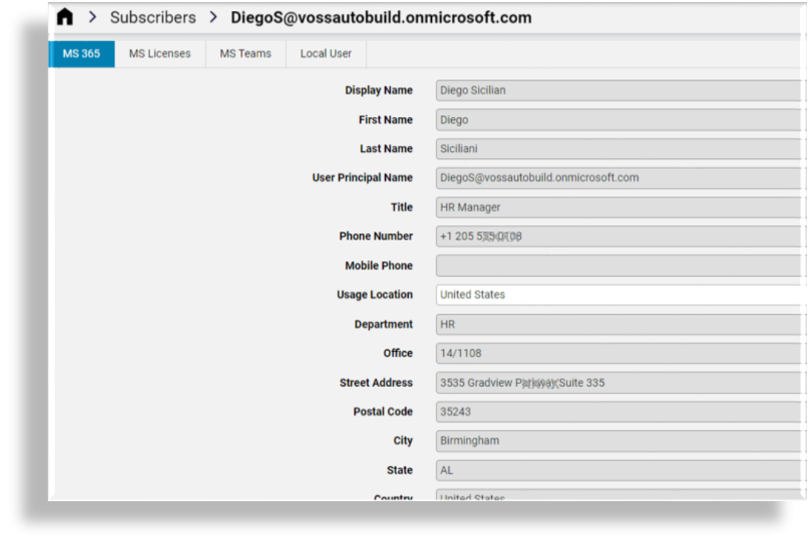
Select a tab (or scroll to the relevant panel) to view and update settings:
Note
Automate allows you to toggle between a panel or tab layout via a toolbar button. The tabs/panels that display depend on enabled functionality.
Tab/Panel
Description
MS 365
Microsoft user details, such as their display name, first and last name, User Principal Name (UPN), title, contact details, usage location, department, employee ID, employee type, and groups.
Exchange Custom Attributes
Read-only. Displays on the user’s form only when Microsoft Exchange is installed and enabled for the user (the user has a Microsoft Exchange license), and provided values are filled out for these fields on the user’s Microsoft Exchange settings in Automate.
These are fifteen additional fields that can be used for filtering from Microsoft Entra ID using model filter criteria, and to have the values available for flow through provisioning. The same fields are also available in the Microsoft Exchange settings (when installed) in Automate.
The fields allow more flexibility when filtering users to be imported and then moved and, optionally, processed with flow through provisioning in Automate.
MS Licenses
View and update the user’s Microsoft license details, including their type (Group or Direct), and their licenses.
Note
When the license type is “Group”, all license details (SKU and service plans) read-only.
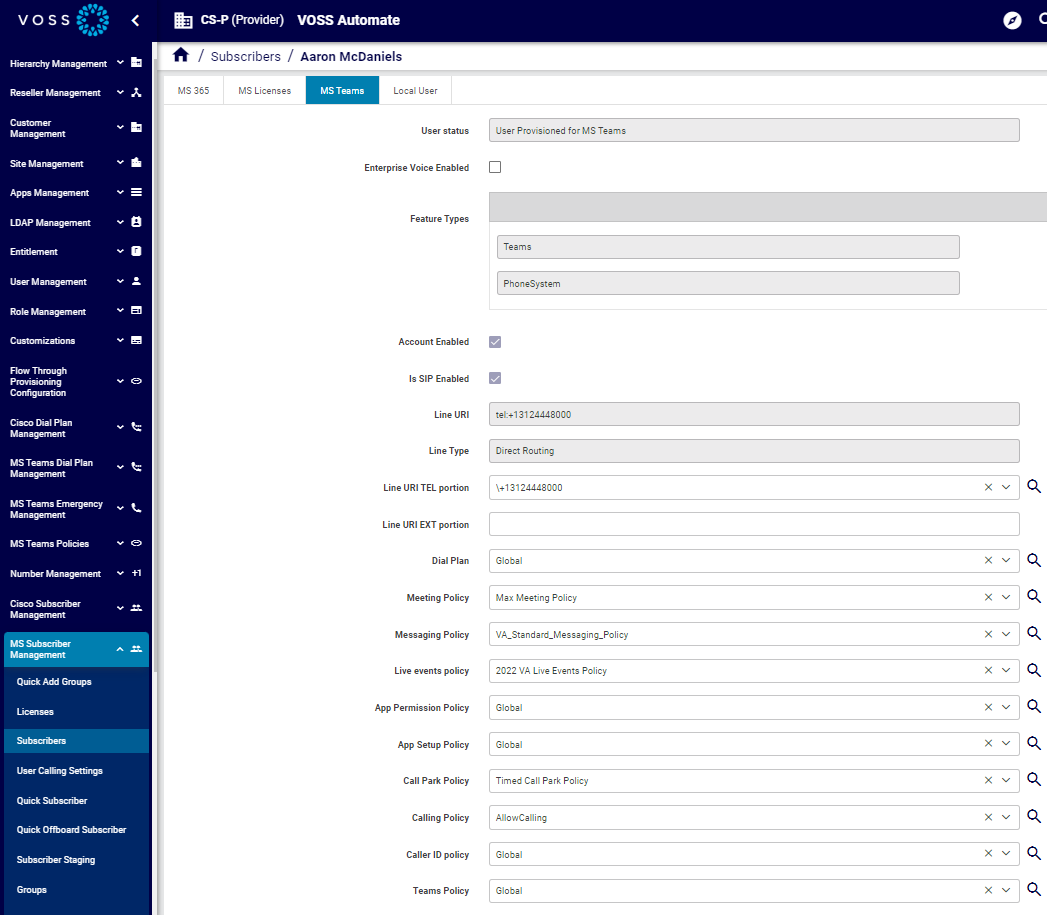
MS Teams
The Microsoft user’s MS Teams details. The fields below are read-only:
User status
Interpreted User Type
Country or Region
Feature Types
Line URI
Line Type
On this tab you can also enable or disable Enterprise Voice for this user.
You can only enable Enterprise Voice for a user that has a PhoneSystem license.
You can only assign a number to a user that has a PhoneSystem license.
Local User
The user corresponding with this user.
Save your changes.
Related Topics
Manage a user’s MS Teams policies#
This procedure displays and updates the policies of individual users via the user edit functionality:
Note
Some policies support full CRUD (create, update, delete) operations within Automate.
Note
This workflow is intended for Microsoft-only users. When choosing a hybrid user with Cisco-Microsoft services, you’ll need to work with this user via the Hybrid multi vendor actions. The Hybrid Status Message field displays the user’s hybrid status. See Hybrid Cisco-Microsoft management
Go to the Microsoft User Details page.
Click on a user to open their settings.
Select the MS Teams tab.
View currently applied policies for the user.
To choose different policies, click the down-arrow at the relevant policy, and select an alternative from the drop-down.
Save your changes. Policy changes are synced back to the Microsoft cloud when performing an overbuild or a sync.
Related topics
Introduction to Microsoft Teams policies in the Core Feature Guide