
Wingman#
Overview#
Automate provides a Wingman Chat AI assistant in the Admin portal that can be activated by a user from any form.
Data Privacy & Architecture Overview#
VOSS uses Microsoft Azure OpenAI Service to provide generative AI capabilities. Customer Data, Prompts, and Completions sent to the VOSS Azure OpenAI instance are not available to other customers or OpenAI and are not used to train base models or improve Microsoft or third-party products without permission.
Azure OpenAI models are stateless in the sense that prompts and completions are not stored in the model itself. In VOSS’s current implementation, we do not use Azure OpenAI stateful storage features such as Responses API message history, Assistants Threads, or stored completions. Where VOSS persists AI history, that persistence occurs only in the deployment’s system of record as described below. (Note: Microsoft preview features may follow different privacy practices.)
1. Deployment Architecture & Data Processing
In our current architecture, inference requests are sent to a VOSS Azure OpenAI resource deployed in East US (Virginia). Data required for inference is therefore processed in that geography. Azure OpenAI applies guardrails and abuse-monitoring controls as part of normal service operation. If stricter geographic processing requirements apply, Azure also offers regional and Data Zone deployment models which can be explored.
Depending on your integration, the VOSS platform is deployed using one of two primary models:
Scenario A: Customer Environment (On-Premises)
System of Record (Persistent Storage): The VOSS platform is hosted within your own Customer Environment. All persisted customer data, including persisted AI chat history and prompts stored by VOSS, remains within your environment and under your control.
Transient AI Processing: Content submitted for live inference is transmitted to the VOSS Azure OpenAI resource in East US for processing.
Scenario B: VOSS-Hosted SaaS
System of Record (Persistent Storage): VOSS hosts the platform in a secure Azure subscription located in the geography as agreed with the customer. All persistent application data and persisted AI history are stored in this deployment’s database.
Transient AI Processing: Real-time inference is routed to the VOSS Azure OpenAI resource in East US.
2. Security Controls & Abuse Monitoring
To ensure data remains secure while utilizing US-based inference, the following controls and Microsoft policies apply:
Guardrails and Abuse Monitoring: As part of its safety controls, Azure OpenAI evaluates prompts and completions for policy violations and indicators of potentially abusive use. By default, content that is flagged by these controls, or associated with a potentially abusive pattern of use, may be subject to further review. This review is conducted primarily by automated means, but in some cases may include review by authorized Microsoft employees under restricted access controls. Microsoft states that customers approved for Modified Abuse Monitoring do not undergo the abuse-monitoring storage and human-review process described above, although automated review may still occur.
Network Transport Security: Communication between the VOSS platform and Azure OpenAI is secured using HTTPS/TLS encryption in transit. VOSS does not currently support Azure Private Link / private endpoints for this integration. For customer on-premises deployments, inference traffic is sent from the customer environment to the Azure OpenAI endpoint over standard secure network paths.
Legal Transfer Mechanisms: International data transfers to the US are governed by the EU-U.S. Data Privacy Framework, the UK Extension to the EU-U.S. Data Privacy Framework, the Swiss-U.S. Data Privacy Framework and the Microsoft DPA with EU Standard Contractual Clauses.
Enabling Wingman Chat#
Wingman Chat is enabled by default, and can be disabled and enabled sysadmin users
and admins with access to the data/Settings model.
For details, see Enable Wingman chat:
Wingman requires internet access (to Microsoft Azure) and
supports connecting via a web proxy. This can be configured by sysadmin users
and admins with access to the data/Settings model and the Web Proxy menu.
For details, see Wingman web proxy and Set up a Web Proxy.
Note
A user role should also be associated with an Access Profile that has Wingman Chat enabled under the Miscellaneous Permissions. From release 24.1, default administrator roles have this permission enabled and an upgrade to 24.1 enables this permission on all existing access profiles.
In order to first use Wingman, an initial manual sync step is required - See: Insights Analytics in the Platform Guide.
For details on Access Profiles and the required administrator level to manage these settings, see:
Using Wingman#
Note
While we strive to ensure and will continue to improve on chatbot accuracy in future releases, the correctness, completeness, or reliability of all results and documentation links is not guaranteed.
Click the Wingman icon on the Automate Admin Portal toolbar to launch the chat pane.

In the chat pane, select the Menu icon (3 dots) adjacent to the New Chat title to display chat history, size and help options for using Wingman Chat:
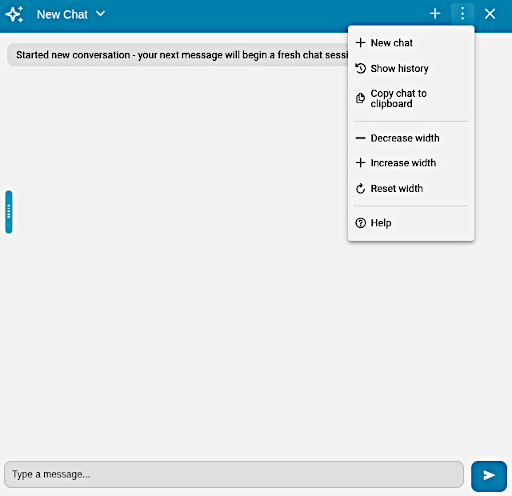
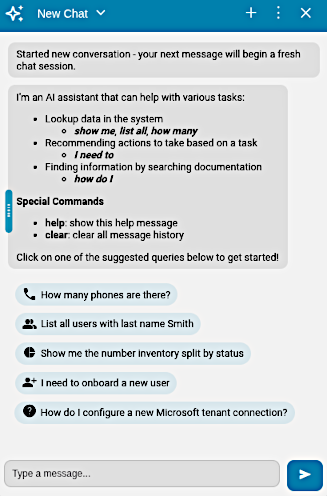
You can also resize the chat pane by dragging the resize button in the left frame. The help menu item opens a list of instruction types and examples that can be selected to test the Wingman response.
Conversation context and chat history#
Wingman retains the context of the current conversation when follow-up questions are asked. For example, if a question is: “many phones?”, then a follow-up question: “by site” will be interpreted within the context of phones, in other words, “how many phones by site”.
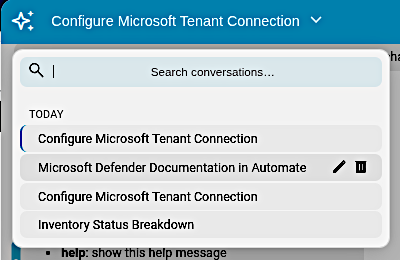
A user’s chat history (up to 100 conversations) is available to the user in the Chat History drop-down.
This user chat history is persistent across sessions and is grouped in TODAY, THIS WEEK and OLDER lists.
Chat history entries can be searched and managed (deleted and re-used), allowing for access to useful and repeatable queries.
Wingman task types#
Three types of tasks can be carried out - each selected by using an appropriate prefix phrase in your chat input:
Show me/List all/How many/Troubleshooting#
Look up data on the platform.
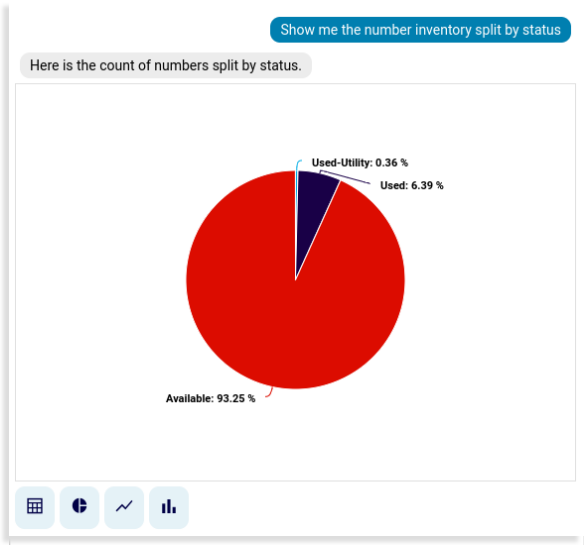
For “Show me” questions, the reply can be rendered in a chart.
Date ranges can also be included into questions, for example: “show me transactions for this week”. The list below provides an indication of the calculation of the date range based on the phrase in the question:
today: from 00:00:00 (UTC) to 23:59:59 (UTC) of the current day.
yesterday: from 00:00:00 (UTC) to 23:59:59 (UTC) of the previous day, in other words, the full 24 hour period of the previous day.
last week: from 00:00:00 (UTC) last Monday to Sunday 23:59:59 (UTC).
last month: from 00:00:00 (UTC) of the first day of the preceding month to 23:59:59 (UTC) of the last day of the preceding month.
last year: from 00:00:00 (UTC) of the first day of the previous year to 23:59:59 (UTC) of the last day of the previous year.
this week: from 00:00:00 (UTC) of the first day of the current week to 23:59:59 (UTC) of the last day of the current week.
this month: from 00:00:00 (UTC) of the first day of the current month to 23:59:59 (UTC) of the last day of the current month.
this year: from 00:00:00 (UTC) of the first day of the current year to 23:59:59 (UTC) of the last day of the current year.
since <specified date>: from 00:00:00 (UTC) of the specified date to 23:59:59 (UTC) of the current day.
since <phrase>: Match start date time to the phrase, but end date must be today’s date time. Examples:
since last week: from 00:00:00 (UTC) last Monday to today’s date.
since yesterday: from 00:00:00 (UTC) to 23:59:59 (UTC) of the previous day to today’s date.
When queries are made without an explicit date range, the default behaviour is “since last week”, for example, if a query was made on September 6th, 2024 at 12:55 UTC:
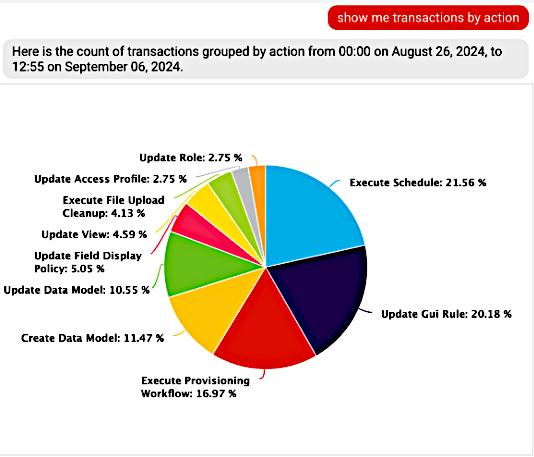
Icons below replies show options to change the chart or output format.
For “How many” questions, Wingman by default responds by showing a bar chart with the count of the data found.
For “List all” questions, Wingman by default responds by showing a table with the data found.
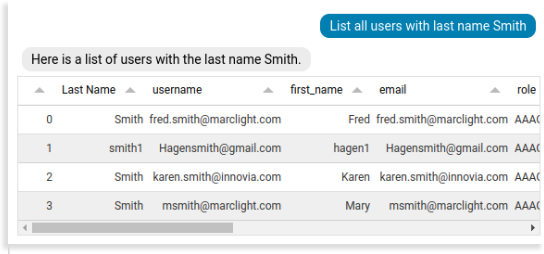
Questions can also be asked about transactions, for example:
Are there any failed transactions?
Why did it fail?
Which transactions are there?
Show me the logs of all severities
Troubleshooting questions can be asked whereby Wingman will follow a detailed playbook to provide a structured problem diagnosis and report.
Important
For the current release of Automate, only a Call Quality playbook is available to Wingman for troubleshooting, so troubleshooting questions need to be about call quality. More troubleshooting playbooks will be added as the most common cases are identified by customers and VOSS Support.
For example, a question such as:
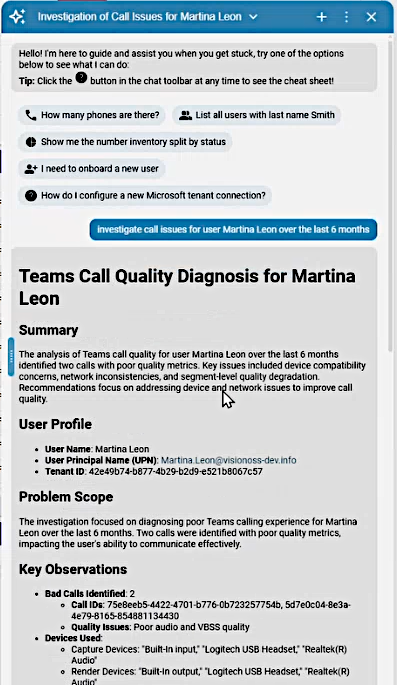
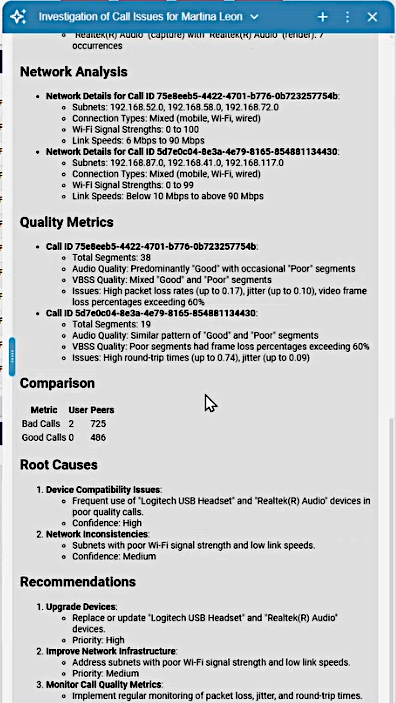
“Investigate call issues for user Martina Leon over the last 6 months”
This will return:
The set of troubleshooting steps to be carried out
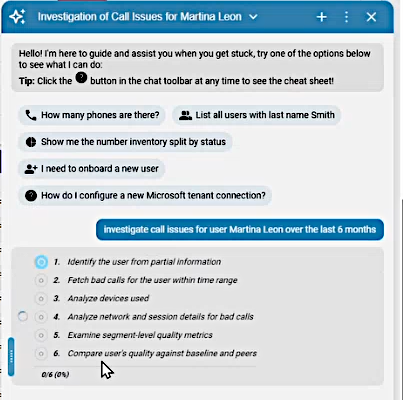
A detailed troubleshooting diagnosis and possible solutions, as shown in the images below:
Note
Wingman will use the permitted dashboard resources in a user’s access profile as valid data lookup options.
Data sources are: Wingman data sources. If a question does not refer to these sources, Wingman responds with the friendly names of these sources as available data sources.
Count results (in tables or charts) are dependent on the hierarchy at which the user is, as well as the user role permissions when using the Wingman chat interface.
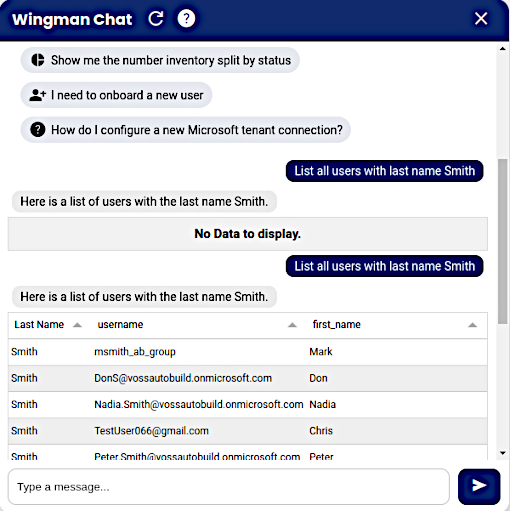
The example below shows responses where an admin user navigates down to a site level hierarchy and asks: “List all users with last name Smith” (result: No Data to display.) and then navigates to a provider level and repeats the question (result: table):
“How many” and “Show me” questions use the Insights data source that is available from release 24.1 and is also used to create dashboard widgets. For details, see: Introduction to VOSS dashboards. This means that while questions for data can be refined by also specifying a single provider, reseller or customer or site hierarchy name in the question, questions do not return data when a question specifies all hierarchies.
I need/want to#
Wingman Chat responds with action recommendations or instructions and with a Go now link - based on user’s menu layout - to the appropriate form, dashboard or feature.
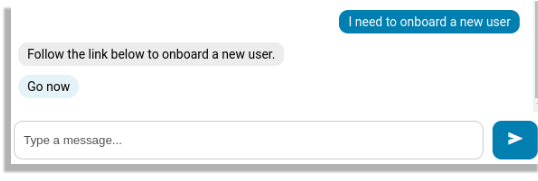
The Go now links use the following models for the matching tasks:
Onboard a new multi-vendor user
view/AddSubscriberFromProfileOnboard a new Microsoft user
view/MicrosoftSubscriberQasOnboard a new Cisco user
view/QuickSubscriberCreate a new Cisco phone
view/AddPhoneAdd a range of numbers to the number inventory
view/NumberInventoryRangeMgmtVIEW
How do I/What is/Tell me about/Explain#
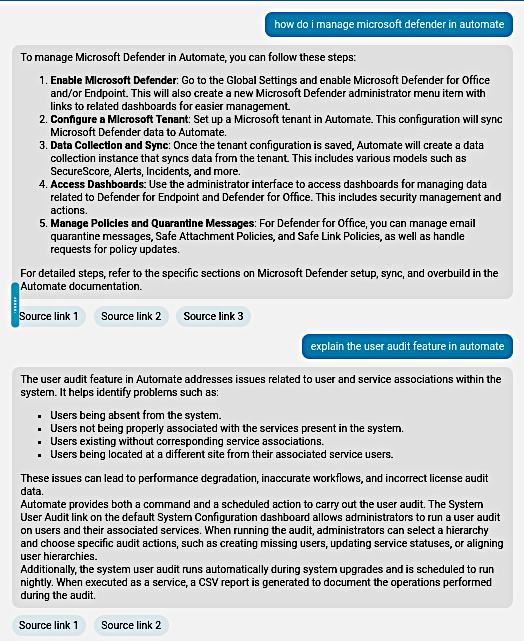
Formulate questions that start with these words to ask documentation questions about the product.
Wingman responds with:
a summarized answer
a set of generated reference links to the full documentation on the documentation portal that may be relevant
Wingman data sources#
The table describes the list of Automate data sources that are available to Wingman when Show me/List all/How many - type questions are asked.
model_type |
friendly_name |
|---|---|
data/MonitoringCluster |
Monitoring Platform Cluster |
data/MonitoringQueue |
Monitoring Transaction Queue |
data/MonitoringSessions |
Monitoring Sessions |
data/MetricDatabaseCollectionStats |
Monitoring Database Stats |
data/LicenseAuditCounts |
Automate License Counts |
data/BaseSiteDAT |
Site |
data/CountLimit |
Subscriber Count Limit |
data/HcsDpDNE164AssociateDAT |
E164 Number Association |
data/HcsDpE164InventoryDAT |
E164 Number Inventory |
data/HcsEntitlementProfileDAT |
Entitlement Profile |
data/HierarchyNode |
Hierarchy |
data/InternalNumberInventory |
Number Inventory |
data/MicrosoftSubscriberQasStaging |
Microsoft Subscriber Staging |
data/User |
User |
device/cuc/User |
Cisco CUC User |
device/cuc/UserLicense |
Cisco CUC User License |
device/cuc/Callhandler |
Cisco CUC Call Handler |
device/cucm/CallPickupGroup |
Cisco UCM Call Pickup Group |
device/cucm/DeviceProfile |
Cisco UCM Device Profile |
device/cucm/Gateway |
Cisco UCM Gateway |
device/cucm/GatewaySccpEndpoints |
Cisco UCM Gateway SCCP Endpoints |
device/cucm/HcsLicense |
Cisco UCM License |
device/cucm/HuntList |
Cisco UCM Hunt List |
device/cucm/HuntPilot |
Cisco UCM Hunt Pilot |
device/cucm/LicensingResourceUsage |
Cisco UCM Licensing Resource Usage |
device/cucm/Line |
Cisco UCM Line |
device/cucm/LineGroup |
Cisco UCM Line Group |
device/cucm/Phone |
Cisco UCM Phone |
device/cucm/PhoneType |
Cisco UCM Phone Type |
device/cucm/RemoteDestination |
Cisco UCM Remote Destination |
device/cucm/RemoteDestinationProfile |
Cisco UCM Remote Destination Profile |
device/cucm/User |
Cisco UCM User |
device/pexip/Conference |
Pexip Conference |
device/pexip/ConferenceAlias |
Pexip Conference Alias |
device/msexchangeonline/UserMailbox |
Microsoft Exchange Online User Mailbox |
device/msgraph/MsolAccountSku |
Microsoft O365 User SKU |
device/msgraph/MsolUser |
Microsoft O365 User |
device/msteamsonline/CsAutoAttendant |
Microsoft Teams Auto Attendant |
device/msteamsonline/CsCallQueue |
Microsoft Teams Call Queue |
device/msteamsonline/CsOnlineUser |
Microsoft Teams User |
device/msteamsonline/CsTeamsClientConfiguration |
Microsoft Teams Client Configuration |
device/spark/Announcements |
Webex Calling Announcements |
device/spark/AutoAttendants |
Webex Calling Auto Attendants |
device/spark/CallParkExtensions |
Webex Calling Call Park Extensions |
device/spark/CallParkGroup |
Webex Calling Call Park Group |
device/spark/CallPickup |
Webex Calling Call Pickup |
device/spark/Device |
Webex Calling Device |
device/spark/HuntGroup |
Webex Calling Hunt Group |
device/spark/Group |
Webex Calling Group |
device/spark/License |
Webex Calling License |
device/spark/Place |
Webex Calling Place |
device/spark/Number |
Webex Calling Number |
device/spark/Schedules |
Webex Calling Schedule |
device/spark/Team |
Webex Calling Team |
device/spark/User |
Webex Calling User |
device/uccx/Agent |
Cisco UCCX Agent |
device/webex/User |
Cisco Webex User |