
Ctrl+K
VOSS Automate 24.2 - Home
  • Automate
  • Compatibility Matrix
  • Core Feature Guide
    • What’s New
    • Conventions Used in this Guide
    • Introduction
      • Welcome to VOSS Automate
      • Unicode Limitations
      • Accessibility
      • Multi Vendor Support
      • Default and Custom Menus in VOSS Automate
      • Product License Management
      • Log In to the Admin Portal
      • Introduction to the Admin Portal User Interface
      • Manage Items
      • Working with Lists
      • Search in VOSS Automate
      • Searchable Fields
      • Case Insensitive Search Fields
      • VOSS Wingman
    • Quick Start Guides
      • Customer Onboarding Quick Start Guide (Multiple Vendors)
      • Microsoft Quick Start Guide for VOSS Automate
    • Hierarchy Management
      • Introduction to Hierarchies
      • Navigate the Hierarchy
      • View the Hierarchy
      • Create a Provider
      • Create a Reseller
      • Create Intermediate Node
      • Delete a Hierarchy
      • Delete Issues and Purges
      • Localization Language
    • Customer Management
      • Customers
      • Network Device Lists (NDLs)
      • CUCM Group Selection
      • CUCM Group Counts
      • Countries
      • Introduction to EMCC
      • EMCC Groups
      • EMCC Route Patterns
      • EMCC Templates
    • Site Management
      • Manage Sites
      • Site Defaults Doc Templates
      • Site Defaults
      • Associate or Disassociate SIP Local Gateway to a Site
    • Apps Management
      • Add Cisco Webex Service
      • Introduction to VOSS Insights Monitoring
      • Arbitrators
      • Onboard Assets
      • Offboard Assets
      • Add a SMTP Server
      • VOSS Phone Server Overview
      • Managing VOSS Phone Servers
      • Adding Phone Types
      • Introduction to Conferencing
      • Conference Workflows
      • Pexip Server
      • AudioCodes Devices
    • Cisco Apps Management
      • CUCM Configuration
      • CUCM Servers
      • Headset Enablement
      • Unified CM Groups
      • Clone an Instance of a CUCM Device Model
      • Multi-Cluster or Single Cluster Configurations
      • Date Time Groups
      • Time Periods
      • Time Schedules
      • Locations
      • Configure Regions
      • Device Pools
      • SIP Profiles
      • Configure SIP Trunk Security Profiles
      • SIP Trunks
      • Route Groups
      • Route Lists
      • CUCM Translation Patterns
      • Calling Party Transformation Patterns
      • Configure Called Party Transformation Patterns
      • CUCM Route Patterns
      • Route Partitions
      • Calling Search Spaces
      • SIP Route Patterns
      • CTI Route Points
      • Softkey Templates
      • Call Park Management
      • Media Resources
      • Add Devices to Application User
      • Add Application Users to Device
      • IP Phone Services
      • Cisco Unified CM Music on Hold (MOH) File Management
      • Introduction to Forced Authorization Codes (FAC)
      • Using Device Models to Manage FAC
      • Using VOSS Automate to Manage FAC
      • Customize Authorization Levels
      • Customize Help
      • Servers (CUC)
      • Schedules
      • Voice Mail Service
      • Associate/Disassociate Voice Mail Services to Customer
      • Pilot Numbers
      • Associate/Disassociate Pilot Number to a Site
      • Call Handler
      • Manage Greeting Files
      • Call Handler (Auto Attendant) Schedule
      • Language Filters
      • Timezone Filters
      • Configure Cisco Emergency Responder (CER)
      • Associate CER with Customers
      • View Associated Clusters on CER Servers
      • Configure Cisco Unified Contact Center Express (UCCX) Server
      • Overview
      • Configure Contact Center Server Using CUCM
      • Built-in-Bridge
      • Configure the Built-in-Bridge
      • Enable or Disable the Built-in-Bridge
      • How to Set Up a Contact Center Server
      • Edit Contact Center Servers
      • Delete Contact Center Servers
      • How to Set Up a Contact Center Service
      • Edit Contact Center Services
      • Delete Contact Center Services
      • Configure CTI Port
      • Tag CTI Port as Contact Center Agent Line
      • Webex Servers
      • IOS Device Management
      • Command Builders
      • Local Break Out (LBO) and Analog Gateway Configuration and Generated Events
      • Local Break Out and Analog Gateway Events, IOS Commands, and Variables
      • MGCP Analog Gateway Events and IOS Commands
      • Translation Rule Numbering
      • Set up an IOS Device
      • Analog Gateways
      • Set up an Analog Gateway
      • Add Port to Analog Gateway
      • SIP Gateway Port
      • Quick Add SIP Gateway
      • Set up SIP Local Gateway
      • Delete a SIP Local Gateway
      • Update a SIP Local Gateway
      • IOS Gateway Manual Configuration
      • Configure Intelligent Proximity for Mobile Voice in VOSS Automate
      • Introduction to UC Prep
      • UCPrep Profiles
      • UCPrep Profile Push
      • Date Time Groups
      • Call Manager Groups
      • Call Manager Host Adjustment
      • Call Manager SIP Trunk Security Profiles
      • Call Manager SIP Profiles
      • Call Manager Audio Codec Preferences
      • Call Manager Application Users
      • Call Manager Feature Control Policies
      • Call Manager Route Filters
      • Unity Authentication Policies
      • Unity User Templates
      • Introduction to Load Balancing
      • Load Balancing Using Site Default Device Pool
      • Associate a CUCM Group to a Device Pool
    • Microsoft Apps Management
      • Microsoft Quick Start Guide for VOSS Automate
      • Introduction to Microsoft UC Integration
      • Microsoft UC Application Setup
      • App Registration
      • Run PowerShell proxy server setup script
      • Test the PowerShell Proxy Connection to the Tenant
      • Sync in Azure Users
      • Sync Microsoft Users to Sites
      • Configure Microsoft Tenant Connection Parameters
      • Create MS Teams Service Account on Microsoft Cloud
    • LDAP Management
      • Add and Configure an LDAP Server
      • LDAP User Sync
      • LDAP Schedule
      • LDAP Custom Role Mappings
      • Introduction to LDAP Authentication in Automate
      • Configure LDAP Authentication-only (standalone)
      • View and Update LDAP Authentication Users
      • Re-provision Synced LDAP Users
      • Run a CUCM LDAP Directory Sync
      • Write back to Active Directory LDAP
    • Entitlement
      • Introduction to Entitlement
      • Entitlement Enforcement
      • Add a Device Type
      • Create Device Group
      • Create an Entitlement Catalog
      • Create an Entitlement Profile
    • User Management
      • Introduction to User Management
      • Users and Subscribers
      • View Users
      • Add Admin Users
      • Updating Users
      • Example End-user Provisioning Workflow
      • User Provisioning Use Cases
      • View a User’s Provisioning Status
      • User Login Options by Auth Method and Server Auth Scope
      • User Authentication
      • Credential Policies
      • Standard Users and Login
      • LDAP Users and Login
      • SSO Users and Login
      • Multi Vendor Subscribers
      • Enable Multi Vendor Subscribers
      • Role-based Access for Multi Vendor Subscribers
      • Introduction to Cisco-Microsoft Hybrid
      • Hybrid Cisco-Microsoft Management
      • Hybrid Service Definitions
      • Hybrid Multi-Vendor Move
      • Introduction to User and Subscriber Syncs
      • User Management Scenarios
      • User Sync Source
      • User Field Mapping
      • Users Synced from LDAP to VOSS Automate
      • User Synced from LDAP to VOSS Automate (SSO Enabled)
      • Users Synced from LDAP to CUCM
      • Users Synced to VOSS Automate
      • Sync or Purge LDAP Users
      • Sync CUCM Users, Lines, Phones
      • LDAP Sync Actions
      • Purge a CUCM User from VOSS Automate Only
      • Create a Filter to Move Users
      • Introduction to Self Provisioning
      • Enable Self Provisioning
      • Bottom-Up User Management
      • Top-Down User Management
      • CUCM Configuration for Self-Provisioning
      • Site Configuration for Self-Provisioning
      • Generate a User’s Primary Line
      • Specify the Primary Line per Subscriber
      • Add a Self Provisioning Universal Device Template
      • Add a Self Provisioning Universal Line Template
      • Add a Self Provisioning User Profile
      • Set a Default User Profile for a Site
      • Add Self-Provisioning Line Mask
      • Pushing Users to CUCM
      • Automatically Move Users Synced from CUCM
      • Move Users
      • Site-to-Site User Move Transaction Log Errors
      • Convert User Type CUCM-LDAP to CUCM Local
      • Managing Duplicate Usernames
      • Manage Local Administrators and Operators
      • Session Timeout Rules
      • Timeout Limit Notifications
      • Manage Passwords
      • Passwords and Manually Added Users
      • Force User Password Change
      • Force Administrator Password Change
      • Change Your Own Password
      • Unlock a Locked Out User
      • Unlock a Locked Out Administrator
      • Manually Disable a User Account
      • Manually Disable Administrator Account
      • Introduction to Self-service
      • Self-service and User Configuration
      • Create a Self-service Link
    • Role Management
      • Role-based Access
      • Authorized Admin Hierarchy
      • User Roles
      • Add and Edit Roles
      • Clone a Role
      • Create a Service Assurance Only Role
      • Create a Fulfillment Only Role
      • Create a Custom Self-service Role
      • Create a Business Admin Role
      • Delete Unused Roles
      • Introduction to Themes
      • Manage Themes
      • Theme Element Color References for the Admin Portal
      • Setting the Default Theme
      • Login Banner
      • Menu Layouts
      • Menu Diff Tool
      • Fixed and Configurable Filters in Menus
      • Landing Page Conversion to Dashboards in Release 24.1
      • Automate Dashboards
      • Introduction to Access Profiles
      • Access Profile Permissions and Operations
      • Customized Credential Policy
      • Assign a Credential Policy to a User
      • Assign a Credential Policy to an Administrator
      • Support for Privacy and Security Notices
      • Privacy Policy Menu Items
      • Manage Privacy Policy Menu Items
      • VOSS Automate Cookie Policy
    • Customizations
      • Introduction to Customizations
      • Global Settings
      • Subscriber Profiles
      • Model Filter Criteria
      • Field Display Policies
      • Configuration Templates
      • Configuration Mapping for Phones, DeviceProfiles, and Lines
      • Dropdown Filters
      • Line Delete Preferences
      • Email
    • Flow Through Provisioning Configuration
      • Setting up Flow Through Provisioning
    • Cisco Dial Plan Management
      • Introduction to Cisco HCS Dial Plan
      • Dial Plan Roles and Privileges
      • HCS Dial Plan Macros in VOSS Automate
      • Customer Dial Plan
      • Site Dial Plan
      • Class of Service (Site)
      • Short Code
      • Directory Number Routing
    • MS Teams Dial Plan Management
      • Introduction to Microsoft Teams Dialplan Management
      • Configure Microsoft Tenant Dialplan
    • MS Teams Emergency Management
      • Introduction to Microsoft Teams Emergency Management
      • MS Teams Emergency Locations
      • MS Teams Emergency Location Networks
    • MS Teams Policies
      • Introduction to Microsoft Teams Policies
    • Number Management
      • Introduction to Number Management in Automate
      • AudioCodes Device Number Integration
      • Number Inventory
      • View Number Details and Usage in the Number Inventory
      • Number Status and Usage
      • Number Range Management
      • Number Cooling
      • Number Reservation
      • Reserve Numbers for a User
      • Audit Number Inventory
      • Number Inventory Alerting
      • Manage Number Filters
      • Introduction to E164 Inventory Management
      • E164 Numbers in the Number Inventory
      • Add an Inventory of E164 Numbers
      • View an E164 Inventory and Delete E164 Numbers
      • E164 Associations ( N to N DN )
      • E164 Associations ( N to 1 DN )
      • Migrate Translation Patterns for E164 to Internal Number Associations
    • Unity SIP Integration
      • Introduction to Unity SIP Integration
      • Configure the Unity SIP Integration Menu Layout
      • Access Profile Changes
      • Unity SIP Integration
      • Integrate Unity-Call Manager
      • Dial Plan Profile
      • Remove Integrate Unity-CallManager
      • Unity Tenant Management
      • Integration Log
    • Cisco Subscriber Management
      • Quick Add Subscriber (Cisco)
      • Add Subscriber from Profile
      • Cisco Subscribers
      • Move Subscriber
      • Phones
      • Headsets
      • Phone Status Export
      • Smart Add Phone
      • Line Search
      • Lines
      • Intercom Lines
      • Agent Lines
      • Voicemail
      • Extension Mobility
      • Single Number Reach
      • Add Device to User
      • Move Phones
      • Moving Phones from Site to Site
      • Replace Phone
      • Reset-Restart Site Phones
      • EM Login/Logout
      • VOSS Phones
      • Quick Add (Subscriber) Groups
      • Class of Service (Subscriber)
      • Reset UC Passwords
      • Pexip Conference Users
      • PLAR (Hotdial)
      • Hunt Groups
      • Call Pickup Groups
      • Provision the Extension Mobility Service
      • Provision the Voice Service
      • Provision the Voicemail Service
      • Provision Webex Service
      • Provision the Pexip Conference Service
      • Provision the Jabber or Dual Mode Device Service
      • Contact Center
      • Introduction to Reassign Services
      • Reassign User Services
      • Update User Details
      • Reassign Services Profile
    • Cisco Webex App
      • Introduction to Cisco Webex App
      • Users (Webex App)
      • Quick Subscriber (Webex App)
      • Bulk Update Webex App Users
      • Workspaces
      • Workspace Call Settings
      • Workspace Locations
      • Webex Locations
      • Webex Location Node Mapping
      • Webex Bulk Actions
      • Webex Schedules
      • Devices (Webex App)
      • Quick Add Device
      • Replace Device
      • Reset Devices to Baseline
      • Device Configuration Profiles
      • Webex App Manual Steps
      • Test Device Configuration Profile Rendering
      • Webex App Licenses
      • Webex App Hunt Groups
      • Webex App Call Park
      • Webex App Auto Attendants
      • Webex App Call Pickup
    • Microsoft Subscriber Management
      • Introduction to Microsoft Onboarding and Offboarding
      • Configure Automate for Microsoft Services
      • Quick Add (Subscriber) Groups
      • Quick Subscriber (Microsoft)
      • Microsoft Subscribers
      • User Calling Settings
      • User Voicemail Settings
      • Quick Offboard Subscriber
      • Microsoft Licenses
      • External Access for MS Teams
      • Groups
      • Teams
      • Manage Group Membership
      • MS Teams Templates
      • Resource Accounts
      • Call Queues
      • Auto Attendants
      • Holidays
      • Microsoft Exchange
      • Microsoft Subscriber Staging
      • MS Blocked Calling Numbers
    • MS Operator Connect Management
      • Microsoft Operator Connect Management in VOSS Automate
    • Overbuild
      • Introduction to Overbuild
      • Overbuild for Cisco
      • Overbuild for Microsoft
      • Run Overbuild
      • Overview Tool
      • Run Dial Plan Overbuild
      • User Phone Associate Tool
      • Overbuild Analog Gateway
      • Device Models
      • Locate a User Associated with a CUC Device Model
      • Filter Calling Search Spaces and Assign a Class of Service
    • Administration Tools
      • Introduction to Import
      • Bulk Load
      • Data Export
      • Bulk Export of Model Data
      • Bulk Load Template Export
      • Bulk Load Sheets
      • Sample Bulk Loaders
      • Bulk Load Template Sheet Layout
      • Export Data Sheet Layout
      • Bulk Load Sheet Macro Evaluation
      • Bulk Load Transactions
      • Alerts
      • Alert Types and Alert Field Reference
      • Transaction Logging and Audit
      • View a Transaction
      • Transaction Log Levels
      • Transaction Details
      • Filter Transactions
      • Filter Sub-Transactions and Logs
      • Transaction Behavior
      • Transaction Priority
      • Transaction Log Example
      • Device Data Sync Errors in Transactions
      • Export a Transaction
      • Northbound Notification
      • Notification Format
      • NBN Transaction Processing
      • Northbound Notification Workflow
      • Configure Northbound Notification Destination
      • Configure Northbound Notification Event Attributes
      • Configure Northbound Notification Event
      • Scheduling
      • Add or Update a Schedule
      • Deactivate and Activate Schedules
      • File Management
      • Create Line Reports for a Site
      • View Line Reports
      • Audit Template Customizations
      • View Template Customization Audit Reports
      • Example Template Customization Audit Reports
      • Settings
      • Set up a Web Proxy
      • Certificate Management for SSO
      • Generate a Certificate for Application Registration
    • Single Sign On (SSO)
      • Single Sign On (SSO) Overview
      • SSO SP Settings
      • SSO Identity Provider
      • SAML Elements in Assertions
    • Data Sync
      • Introduction to Data Sync
      • Default Cache Control Policy
      • Data Sync Types
      • Full Sync
      • Enable a Scheduled Data Sync
      • Manually Run the Default Data Sync
      • Controlling a Data Sync with a Model Type List
      • Create a Targeted Model Type List
      • Model Instance Filter
      • Allowlists and Denylists
      • View List of Device Models
      • Create a Custom Data Sync
      • CUCM Change Notification Alerts
      • Introduction to Change Notification Sync
      • Enabling / Disabling CNF Syncs for a CUCM cluster
      • VOSS Automate Change Notification Functionality
      • Troubleshooting Change Notification (CNF)
      • Shared Line Across Sites
      • Shared Line Across Sites Example
      • Shared Line Across Sites Example Diagram
      • Inventory Site
      • Inventory Site Diagram
      • Dial Plan Type for Shared Line Across Sites
      • Class of Service for Shared Line Across Sites
      • Call Forward Considerations for Shared Line Across Sites
      • Phone, Subscriber, and Quick Add Subscriber use for Shared Line Across Sites
      • Hunt Groups and Call Pickup Groups for Shared Line Across Sites
      • Hunt Groups and Call Pickup Groups for Shared Line Across Sites Example
      • Site Short Codes
      • Handling Voice Mail to Secondary Shared Lines
      • Configure Shared Line Across Sites
    • Self-service Administration
      • Introduction to Self-service Administration
      • Self-service Feature Display Policy
      • Self-service Feature Display Policy Field Reference
      • End User Access and Authentication
      • Themes and Branding
      • Self-service Login Banner
      • Personal Phones (Remote Destinations)
      • Dual Mode Phones - Mobile ID
      • Voicemail for Self-service
      • Links Page
    • Advanced Tools for System Administrators
      • Add Custom Variables
      • Create Model Report
      • Manage Model Reports
    • Appendix: Optional Features
      • Dial Plan Management Tool
      • Cisco Custom Dial Plans
      • Dial Plan Maintenance
      • Multi-Cluster Dial Plan Maintenance
      • Dial Plan Viewer
      • Dial Plan Input Data
      • Dial Plans
      • Cisco Dial Plan Models
      • Microsoft Dial Plan Models
      • Dial Plan Model Bulk Loader
      • Dial Plan Log
      • Move Number Inventory Instances
      • Introduction to Phone-Based Registration (PBR)
      • Add Phone-Based Registration Menus and Access Profile
      • Create Restricted API Role and Admin User
      • Install Phone-based Registration (PBR) Web Service
      • Add PBR Config Records
      • PBR Setup - Configure CUCM for AutoRegistration and Phone Based Registration
      • Register a Phone for Phone Based Provisioning
      • Introduction to Phone Services
      • Configure Phone Services
      • Manage Phone Services
      • Call Redirection Routing Plan for Disaster Recovery
    • Appendix: Glossary
      • Glossary
  • Self-service Guide
    • Purpose
    • Audience
    • Conventions
    • Accessing Self-service
    • First Login and Password Expiry or Reset
    • Accessing Minimal Mode
    • Manage Your Self-service
    • Configure Your Password Reset Questions
    • Reset Your Password
    • User Interface
    • Available Features and Services
    • Session Timeout
    • Buttons and Icons
    • Common Tasks
    • Home
    • My Information
    • Change Your User Language
    • Manage Your Password and PIN
    • Change Your Password
    • Password Hints and Rules
    • Change Your PIN
    • Access Webex
    • Phones
    • Manage a Phone
    • Add Your Own Smart Device
    • Edit a Smart Device
    • Bulk Modify Your Company Phones
    • Your Personal Phone Management
    • Add a Personal Phone
    • Edit a Personal Phone
    • Delete a Personal Phone
    • Bulk Modify Your Personal Phones
    • Voicemail Settings
    • Create your own Voicemail Account
    • Change your Voicemail Settings
    • Alternate Numbers and Notification Devices
    • Manage Alternate Numbers and Notification Devices
    • Caller Input
    • Manage Caller Input Keys
    • Message Actions
    • Manage Message Actions
    • Call Forwarding
    • Activate and Manage a Line for Call Forwarding
    • My Availability
    • Set Do Not Disturb for your Phone
    • Speed Dials and BLFs
    • Manage Speed Dials and Busy Lamps (Phone Button Template)
    • Add a Speed Dial (Abbreviated Dials)
    • Links
  • Architecture and Hardware Specification Guide
    • VOSS Automate Deployment Topologies
    • VOSS Automate Hardware Specifications
    • Scale and Performance
  • Installation Guide
    • Overview
    • Command Conventions
    • VOSS Automate Deployment Topologies
    • Multi Data Center Deployments
    • Clustering Considerations
    • Network Communications between Nodes within the Cluster
    • Network Communications External to the Cluster
    • Cluster Commands
    • Geo-redundancy/Redundancy And DR Synopsis
    • Network Docker Container Range
    • Backup Size Considerations
    • VOSS Automate Hardware Specifications
    • VOSS Automate Hardware Specifications
    • Installation Process
    • Create a New VM Using the Platform-Install OVA
    • Using the screen command
    • Installation Logs
    • Commands to Determine the Primary Node Role in a Cluster
    • Multinode Installation
    • Single-node cluster (cluster-of-one) Installation
    • View Installation and Upgrade Transactions
    • Installation Quick Reference
    • Migrating from a 6 Node to 8 Node System
    • Modular Architecture Multinode Installation
    • Deployment into the Azure Cloud
    • AWS Deployment Guide
  • Upgrade Guide with ISO and Template
    • What’s New
    • Before Upgrading
    • Upgrade and Data Migration
    • Using the screen command
    • VOSS Automate Hardware Specifications
    • Upgrade Unified Node Topology
    • Upgrade Modular Cluster Topology
    • Upgrade a Single Node Cluster Environment
  • Upgrade Guide with Delta Bundle
    • What’s New
    • Dependencies
    • Delta Bundle Overview
    • Important Information
    • Download Location
    • Install Procedure for a Unified Node Topology
    • Install Procedure for a Modular Cluster Topology
    • Install Procedure for a Single Node Cluster Environment
    • Post-Checks
    • Rollback
  • Multi-Cluster Deployments Technical Guide
    • Introduction
    • Deployment Recommendations
    • Caveats and Limitations
    • Overview
    • Deployment Recommendations
    • Caveats and Limitations
    • Overview
    • Deployment Recommendations
    • Caveats and Limitations
    • Deployment Recommendations
    • Deployment Recommendations
    • Caveats and Limitations
    • Overview
    • Number Inventory
    • HCS Dial Plans GDPR Support
    • HCS Dial Plan Type Considerations for GDPR
    • ILS/GDPR
    • Intercluster Trunking
    • HCS Dial Plans
    • Overbuild Considerations
    • Scenarios
    • Notes
    • Single telephoneNumber MIF
    • Multiple telephoneNumber MIF
    • Intercluster Trunking, ILS/GDPR CFTs
  • Platform Guide
    • What’s New
    • High-level Functions
    • Overview
    • CLI Commands
    • Cluster Commands
    • Using the screen command
    • VOSS Management Tools
    • Install Commands
    • Database Commands
    • Database Commands for Transaction Management
    • Performance Commands
    • System Specific Commands
    • Transaction Archiving
    • Product Licensing
    • Report Transaction Commands
    • Report API Commands
    • Introduction
    • Subscriber Data Export Command
    • Deployment Commands
    • Migrate a Unified Node Cluster to a Modular Cluster
    • Commands to Determine the Primary Node Role in a Cluster
    • Provisioning
    • Network interfaces
    • Switching Network Addresses from IPv4 to IPv6
    • Network services
    • Network URI specification
    • Network Docker Container Range
    • Application Control and Status
    • Starting and Stopping
    • Installing Applications
    • Updating Applications
    • Summary Attribute Migration
    • Remote Execution in Clusters
    • List of Unused Cluster Commands
    • Self-service Localization Management
    • Web Services
    • Insights Analytics
    • System Commands Overview
    • System restart
    • Passwords
    • System Boot Passwords
    • Federal Information Processing Standards (FIPS)
    • File Management
    • Drive control
    • Transaction Prioritization
    • Banner
    • Maintenance Mode
    • Checksum
    • Terminal Reset
    • Login Report
    • Cluster Check
    • Enable Health Monitoring
    • Enable Database Scheduling
    • Command History
    • Logs
    • Viewing Logs
    • Sending and Collecting Logs
    • Log Types
    • Audit Log Rule Sets
    • Log Type Commands
    • Audit Log Format and Details
    • Event Log Format and Details
    • Log Streaming
    • Remote Log Type Encryption
    • The Mail Command
    • Diagnostic Tools
    • Diagnostic Troubleshooting
    • Warnings and Notifications
    • Events and SNMP Messages
    • SNMP Configuration and Queries
    • Introduction to SNMP and MIB
    • SNMP Traps
    • Management Information Bases
    • Notification Messages
    • SNMP Traps: Number Inventory Alerting
    • SNMP Traps: System Monitoring
    • Scheduling
    • Internal Report Schedules
    • Backups
    • Backup and Restore in a Modular Architecture
    • Backup Destinations
    • Backup Passphrase
    • Backup Size Considerations
    • Create a Backup
    • Restore a Backup in a Clustered Environment
    • Create Space for a Backup or Restore
    • Maintaining Backups
    • Backup and Import to a New Environment
    • VMware Snapshot Maintenance
    • Backup on Azure
    • Introduction to Restoring Backups on a New Environment
    • Setting up the Backup Passphrase on a New Environment
    • Adding More Hard Disk Space
    • Reassign Current Drives (Backup and DBroot)
    • Restore the Backup
    • Example of a Successful Restore
    • Security Overview
    • Security Patches and Updates
    • Configuration Encrypted
    • Backup Encrypted
    • Application Install Files Encrypted
    • File Integrity
    • Protected Application Environments (Jails)
    • Restricted User Shell
    • User Security and Security Policy Management
    • Creating Additional Users
    • Creating and Managing SFTP Users
    • Granting and revoking user rights
    • Password Strength Rules
    • SSH Login Fail Limit
    • SSH Session Limit
    • SSH key management
    • SSH Algorithm Management
    • Adding a Key for Automatic User Login
    • Prevention of DOS Attacks
    • Memory Dumps and Security
    • Manage Read-Only Database Users
    • Network Communications between Nodes within the Cluster
    • Network Communications External to the Cluster
    • Dynamic Firewall
    • Web Certificate Setup Options
    • Supported SSL Ciphers
    • VOSS Automate Setup a Web Certificate
    • Own Web Certificate Setup
    • Web Certificate Expiration Notice
    • Convert Web Certificates from P7B to PEM Format
    • Web Certificate Commands
    • Web Hosts Commands
    • Web TLS Protocol Configuration
    • Web TLS Cipher Management
    • Network URI specification
    • Web External Proxies
    • High Availability Overview
    • Default HA and DR scenario
    • HA and DR scenario with Cisco VMDC geo-redundancy architecture
    • Configuring a HA System Platform on VMware
    • DR Failover
    • Cluster Failure Scenarios
    • Create a New VM Using the Platform-Install OVA
    • Election of a New Primary and Failover
    • DR Failover and Recovery Scenarios
    • Scenario: Power Off and On of a Node
    • Scenario: Loss of a Non-primary Node in the Primary Site
    • Scenario: Loss of a Non-primary Server in the DR Site
    • Scenario: Loss of the Primary Database Server
    • Scenario: Loss of a Primary Site
    • Scenario: Loss of a DR Site
    • DR Failover and Recovery in a 2 Node Cluster
    • Scenario: Loss of Full Cluster
    • Modular Cluster: Election of a New Primary and Failover
    • DR Failover and Recovery Scenarios in a Modular Cluster
    • Scenario: Power Off and On of a Node in a Modular Cluster
    • Scenario: Loss of an app node: Modular Cluster
    • Scenario: Loss of the Primary Database Server in a Modular Cluster
    • Scenario: Loss of a non-primary database: Modular Cluster
    • Scenario: Loss of a Primary Site in a Modular Cluster
    • Scenario: Loss of a DR Site in a Modular Cluster
    • Scenario: Loss of Full Cluster in a Modular Cluster
    • Platform User Password Recovery Procedure
    • ‘No Space Left on Device’ Error
    • Loss of the whole cluster and redeploying new servers
    • Error Messages
    • MIB List
    • Analogue line MGCP Data Export
    • Analogue Line SCCP Data Export
    • Call Pickup Group Data Export
    • Contact Center Enterprise Data Export
    • Contact Center Express Data Export
    • Customer Data Export
    • Extension Mobility Data Export
    • FMC Data Export
    • Hunt Group Data Export
    • Hybrid Data Export
    • Line Data Export
    • Phones Data Export
    • Site Data Export
    • Subscriber Data Export
    • Webex Teams Data Export
    • Webex Devices Data Export
    • Webex Workspaces Data Export
    • MS Office 365 Data Export
    • MS Teams Data Export
    • MS Exchange Data Export
    • Pexip Data Export
    • VOSS Phone Servers Data Export
    • diag Command Examples
    • SNMP Traps: Applications examples
    • SNMP Traps: Load examples
    • SNMP Examples: Backup
    • SNMP Trap Examples
  • Health Checks for Cluster Installations Guide
    • Introduction
    • Notification/SNMP setup
    • Check General Cluster Health
    • Verify Web Proxy Sanity
    • Verify Database Status
    • Resource Utilisation Checks
    • VMWare Checks
    • Backup / Export
    • Latency
    • Firewall configurations
    • Data Collection for Offline Analysis
  • Best Practices Guide
    • VOSS Automate Deployment Topologies
    • Overview
    • Active-Active Web Weights
    • Active-StandBy Web Weights
    • Session Limits
    • Throttle Limits
    • Configurable Number of Queue Processes
    • Guidance on Planning for Onboarding and Ongoing Operations
    • Sync Overview
    • Data Sync Types
    • Scheduling Syncs
    • Cisco Unified CM Sync
    • Update Sync Operations
    • Staggering of CNF Syncs Across Customers
    • Recommended CUCM Sync Setups
    • Cisco Unity Connection Sync
    • LDAP Sync
    • Cisco Webex App Sync
    • Microsoft Sync Overview
    • Microsoft Entra ID and Office365 MSOLUser Filter Examples
    • Recommended RIS API Data Collector Interval
    • API Resource Listing Best Practice
    • Long Running API Requests
    • Transaction Archiving
    • Automated Database Cache Cleanup
    • Navigation - Menu and Dashboards
  • Advanced Configuration Guide
    • What’s New
    • Login Banner
    • Transaction Log Levels
    • Settings
    • Global Settings
    • Number Cooling Auto Expiry Schedule
    • Add a SMTP Server
    • Email
    • Associate and Disassociate Devices to Application Users
    • INI Purge Tool
    • System Monitoring Configuration
    • System Monitoring Database Statistics
    • System Monitoring Model Counts
    • VOSS Automate Cluster Status
    • UC Apps Reachability
    • Worker Queue
    • Login Sessions
    • Feature Package Customization
    • Field Display Policies
    • Field Display Policy Input Reference
    • Example Field Display Policy Clone
    • Configuration Templates
    • Create a Configuration Template
    • Configuration Templates for Array Updates
    • Events
    • GUI Rules
    • GUI Rule for the Target Model of a Configuration Template
    • Relations
    • Tags
    • Add and Remove Tags
    • Create a View
    • Less Files and Customizing Themes
    • Theme Banner Customization
    • Privacy Policy Menu Items
    • Manage Privacy Policy Menu Items
    • Manage Themes
    • Theme Element Color References for the Admin Portal
    • VOSS Automate Cookie Policy
    • Menu Diff Tool
    • On-line Help Customization
    • Online Help Model Override Options
    • Scripts
    • Create and Run a Script
    • Expect Script Examples
    • Expect Script Import Format
    • Network Device List Selection Rules Advanced Configuration
    • Change LDAP User Sync from Top-Down to Bottom-Up
    • Data Sync Workflows Reference
    • Number Inventory Flexibility and Description Customization
    • Configuration Overview
    • Site Defaults Reference
    • Named Macros Overview
    • Customizing Quick Add Groups
    • Quick Add Subscriber Provisioning Workflow Structure
    • Subscriber Relation Context
    • Config Template Looping and Merging Overview
    • Config Template Looping
    • Config Template Merge Strategy
    • Custom Line Settings for Smart Add Phone Configuration Template
    • Reference Material
    • Lines Site Defaults
    • Phones Site Defaults
    • Subscriber Site Defaults
    • Quick Subscriber Site Defaults
    • Voicemail Site Defaults
    • Webex Site Defaults
    • Hot Dial PLAR Site Defaults
    • Hunt Groups Site Defaults
    • Call Pickup Groups Site Defaults
    • Configuration Template Reference List
    • Named Macros Available to Administrators
    • Named Macros - Site Defaults General
    • Named Macros - Site Defaults Device
    • Named Macros - Site Defaults Line
    • Named Macros - Site Defaults User
    • Named Macros - Site Defaults CUC
    • Named Macros - Site Defaults Hotdial
    • Named Macros in Configuration Templates
    • Pull Sync Delete Threshold
    • Macros
    • Macro Syntax Brackets
    • Macro Syntax Multiline
    • Dot notation
    • SELECT FROM WHERE Macro Syntax
    • Macro Nesting
    • Macro Syntax to Filter by Meta Properties
    • Macro Function Syntax
    • Numeric Functions
    • String Functions
    • List Functions
    • Model Filters
    • Model Instance Filters (MIF) from CSV File
    • Rule Filter Functions
    • Role at Allowed Hierarchy Function
    • Filter Role Functions
    • Macro Evaluate Function
    • CUCM and Device Functions
    • Jabber Device Name Function
    • Webex App Functions
    • Subscriber Functions
    • Quick Add Group Functions
    • Zero, Unset, Boolean, Drop, Null and Exists Functions
    • Time Functions
    • Hierarchy Functions
    • User Details Functions
    • Number Management Functions
    • Phone Functions
    • Localization Functions
    • Log Functions
    • Object Functions
    • Conversion Functions
    • HTTP Functions
    • Email Functions
    • Macro Examples - Simple
    • Macro Examples - List Macro
    • Macro- and Macro Function Nesting
    • Conditional Logic Macro Function
    • Create a Macro In-line
    • Create a Macro for Re-use
    • Create a Value Substitution Macro
    • Substitution Macro Examples
    • Create an Evaluation Macro
    • Evaluation Macro Examples
    • Macro Evaluator
  • BulkLoader Provisioning Guide
    • Overview
    • Bulk Load
    • Data Export
    • Bulk Load Template Export
    • Bulk Load Sheets
    • Bulk Load Template Sheet Layout
    • Sample Bulk Loaders
    • Export Data Sheet Layout
    • Template Location and Template Reference Set
    • Bulk Load Sheet Macro Evaluation
    • Bulk Load Transactions
    • Bulk Export of Model Data
    • Bulk Load API
  • Provider HCS Dial Plan Management Support Guide
    • What’s New
    • Telephony, Design, and HCS Dial Plan Overview
    • Introduction to the Dial Plan Model in VOSS Automate
    • Dial Plan Roles and Privileges
    • Customer Dial Plan
    • Site Dial Plan
    • Class of Service (Site)
    • Short Code
    • Directory Number Routing
    • Customers
    • Introduction to Number Management in Automate
    • Number Inventory
    • View Number Details and Usage in the Number Inventory
    • E164 Numbers in the Number Inventory
    • Number Status and Usage
    • Number Range Management
    • Number Cooling
    • Number Reservation
    • Number Inventory Alerting
    • Audit Number Inventory
    • Introduction to E164 Inventory Management
    • Add an Inventory of E164 Numbers
    • View an E164 Inventory and Delete E164 Numbers
    • E164 Associations ( N to N DN )
    • E164 Associations ( N to 1 DN )
    • Migrate Translation Patterns for E164 to Internal Number Associations
    • Configure Inter-site Cross-cluster Support
    • Manual Configuration for Local Breakout Support
    • Voice Mail Service
    • Associate/Disassociate Voice Mail Services to Customer
    • Pilot Numbers
    • Creating DDIs for Voice Mail Pilot Numbers
    • Associate/Disassociate Pilot Number to a Site
    • Adding Aggregation Trunk and Route Group and Associating to Existing Route List and SLRG
    • SIP Profiles
    • SIP Profile Field Descriptions
    • Configure SIP Trunk Security Profiles
    • SIP Trunk Security Profile Field Descriptions
    • SIP Trunks
    • SIP Route Patterns
    • Route Groups
    • Route Lists
    • Date Time Groups
    • Locations
    • Device Pools
    • Configure CUCM Groups
    • Route Partitions
    • Calling Search Spaces
    • Calling Party Transformation Patterns
    • Configure Called Party Transformation Patterns
    • CTI Route Points
    • Time Periods
    • Time Schedules
    • Clone an Instance of a CUCM Device Model
    • Introduction to Load Balancing
    • Load Balancing Using Site Default Device Pool
    • Associate a CUCM Group to a Device Pool
    • Update the USA Device-Based Routing Dial Plan
    • Shared Line Across Sites
    • Shared Line Across Sites Example
    • Shared Line Across Sites Example Diagram
    • Inventory Site
    • Inventory Site Diagram
    • Dial Plan Type for Shared Line Across Sites
    • Class of Service for Shared Line Across Sites
    • Call Forward Considerations for Shared Line Across Sites
    • Phone, Subscriber, and Quick Add Subscriber use for Shared Line Across Sites
    • Hunt Groups and Call Pickup Groups for Shared Line Across Sites
    • Hunt Groups and Call Pickup Groups for Shared Line Across Sites Example
    • Site Short Codes
    • Handling Voice Mail to Secondary Shared Lines
    • Configure Shared Line Across Sites
    • Configure Tail End Hop Off
    • HCS Dial Plan Macros in VOSS Automate
    • Auto-Cloning of Dial Plan Schemas and Schema Groups to the Provider Hierarchy Node
    • Dial Plan Schemas
    • Clone Dial Plan Schemas
    • Site Defaults
    • Run Overbuild
    • Overriding Unified CM Group
    • Dial Plan Schema Group
    • Associate Custom Dial Plan Schema Group
    • Default Dial Plan Schemas
    • Emergency and CLI Settings
    • Default Dial Plan Event Triggers
    • Manual Configuration to Correct Calling Presentation Overwrite on Calls Forwarded to PSTN
    • Global Settings
    • Add a SMTP Server
    • Email
    • Intra-Site Extension Dialing
    • Multi-Site Customer with ISP Included in SLC
    • Multi-Site Customer with Extension Prefix and no ISP
    • Single Site Customer
    • Customer (Single- or Multi-Site) Without PSTN Prefix
    • Multi-Site Customer with ISP
    • Intra-Site On-Net Call
    • Inter-Site On-Net Call
    • VoIP Trunking On-Net Call
    • Local Gateway (LBO)
    • Aggregation (CBO)
    • VoIP
    • Non-CER Through Aggregation
    • Non-CER Through Local Gateway
    • Cisco Emergency Responder
    • Introduction to PSTN Call Processing and Routing
    • Dial Plan Determination
    • Country Dial Plan Deployment Overview
    • Predefined Country Dial Plans
    • Install Country Dial Plan (.template file)
    • Install Country Dial Plan (.json file)
    • Add a Country Dial Plan to a Dial Plan Before Deploying to a Customer
    • Add a Country Dial Plan to a Deployed Customer Dial Plan
    • Called Party Number As Dialed Feature
    • Plus Number Dialing Customization
    • Correct Device Based Routing Class of Service to Enable Single Number Reach
    • Dial Plans for Caribbean Countries Overview
    • North American Numbering Plan Schema
    • Caribbean Countries Schema (Optional)
    • Country Specific Schema
    • Installing the Dial Plan
    • Local Breakout (LBO) Workflows
    • Calling Search Spaces and Partitions
    • Architecture Primer
    • Directory Numbers Classification
    • Extension Numbers
    • Site Location Codes
    • Full National Number
    • E.164 Number
    • Intersite Prefix
    • PSTN Access Prefix
    • Call Limitations
  • Licensing and Subscriber Data Export Guide
    • What’s New
    • License Count
    • License Counting Details
    • License Audit Report File Details
    • Process Command Details
    • Distributing Licensing Reports
    • Set up a Web Proxy
    • Troubleshooting and Error Handling
    • Introduction
    • Subscriber Data Export Command
    • Scheduling
    • Using the screen command
    • Analogue line MGCP Data Export
    • Analogue Line SCCP Data Export
    • Call Pickup Group Data Export
    • Contact Center Enterprise Data Export
    • Contact Center Express Data Export
    • Customer Data Export
    • Extension Mobility Data Export
    • FMC Data Export
    • Hunt Group Data Export
    • Hybrid Data Export
    • Line Data Export
    • Phones Data Export
    • Site Data Export
    • Subscriber Data Export
    • Webex Teams Data Export
    • Webex Devices Data Export
    • Webex Workspaces Data Export
    • MS Office 365 Data Export
    • MS Office 365 Service Plans
    • MS Teams Data Export
    • MS Exchange Data Export
    • Pexip Data Export
    • VOSS Phone Servers Data Export
    • Network Communications External to the Cluster
  • API Guide
    • What’s New
    • API Introduction
    • API System Concepts
    • Hierarchy
    • Basic REST
    • API Traversal
    • Request and Response Patterns
    • General Structure of the API
    • Format
    • Authentication
    • Authorization
    • HTTP Methods
    • PUT Versus PATCH
    • API Parameters
    • Filter Parameters for Choices
    • API Request Headers
    • Login and Authorization Tokens
    • Non-interactive Login
    • Access Profiles
    • Time to Live (TTL)
    • Account Endpoint
    • API Response Overview
    • API Response Header
    • Single Resource Response
    • Resource List Response
    • POST/PUT/DELETE/PATCH Response
    • Asynchronous Mutator Transaction Status Callback
    • Example of an Asynchronous Mutator Transaction with nowait=true
    • Correlation Identifiers
    • Example Of A Simple HTTP Server
    • Developer Guidelines
    • Workflow Tasks
    • Developer Tools
    • Fault Responses
    • Error Messages
    • Introduction to Tool APIs
    • Search and Search Result Export
    • Bulk Load API
    • Move and Bulk Move
    • Data Extract
    • Custom Workflows
    • List Transactions
    • Get Instance Transactions
    • Poll Transactions
    • Replay Transactions
    • Edit and Replay Transactions
    • Sub Transactions
    • Log Transactions
    • Transaction Choices
    • Transaction Filters
    • API Examples Overview and Conventions
    • POST
    • GET
    • PUT
    • DELETE
    • Bulk Load Example
    • Export Example
    • Example Transaction
    • API Backward Compatibility and Import
    • Using the API Reference
    • API Schema
    • Notifications
    • Metadata
    • References
    • Summary Attributes
    • Path
    • Model Type
    • Actions
    • Singleton
    • Choices Generic Action
    • Add Generic Action
    • Bulk Update Generic Action
    • Clone Generic Action
    • Configuration Template Generic Action
    • Create Generic Action
    • Delete Generic Action
    • Execute Generic Action
    • Export Generic Action
    • Export BulkLoad Template Generic Action
    • Field Display Policy Generic Action
    • Help Generic Action
    • List Generic Action
    • Update Generic Action
    • Import
    • Test Connect
    • Apply
    • Assign
    • Do
    • Lock
    • Promote
    • Reset
    • Vendor Config
    • Wipe
    • Update LDAP Authentication
    • Update LDAP System
    • Data
    • Resources
    • Schema
    • Pagination
    • Introduction to Automate OpenAPI Examples
    • GET /tool/Macro
    • Add a standalone Cisco phone
    • Add a Cisco subscriber
    • Reset a CUCM PIN/password and/or CUC PIN
    • Replace a Cisco phone
    • Associate an existing Cisco device or device profile to subscriber
    • Disassociate a Cisco phone from a subscriber
    • Move a Cisco subscriber between sites
    • Modify line data
    • Modify phone data - line recording details
    • Delete a phone
    • Delete a subscriber
  • Language Pack Guide
    • Languages Overview
    • Language Availability and Installation
    • Localization Coverage and Caveats
    • Default Language and User Language
    • Selfservice User Languages
    • Language Customization
    • Installation of New Languages
    • Updates to Languages
  • NBI Technical Description and Deployment Guide
    • Overview
    • Introduction
    • NBI Technical Description
    • Billing Payload Definition
    • Integration Considerations and Message Sequencing
    • Operational Matters and Production Hardening
    • Appendix A: Trigger Events and Tracking Table
    • Appendix B: Billing Payload Definition
    • Appendix C: Alarm Definition
  • NBI Troubleshooting Guide
    • NBI SNMP Traps
  • NBI Install Guide
    • Overview
    • Before You Start
    • Software Details
    • Download the Relevant Files
    • VOSS Automate verification
    • Deploy the new install OVA
    • Install and Configure the NBI Application
    • NBI Checks
  • Open Source License Usage
    • Core Application (Python)
    • Platform (Python)
    • Portal (JavaScript)
    • Self-service (JavaScript)
    • Insights API (JavaScript)
    • Insights - VOSS Sync (JavaScript)
    • VOSS Automate Licensing Service
    • Licenses for Code in Binary Files
    • Open Source Licenses for Release 24.2
  • Index
  • .rst
  • Index »
  • Core Feature Guide »
  • Hierarchy Management »
  • Navigate the Hierarchy

Navigate the Hierarchy

  On this page

  • Overview
  • Hierarchy tree view
  • Switching to a different site
  • Hierarchy list view links

Navigate the Hierarchy#

Overview#

The Automate Admin Portal allows you to navigate to a particular hierarchy level and to set the context for various actions in the system at that level via the Organization Selection toolbar button, or to view a list of hierarchy nodes at your currently selected hierarchy in a list view.
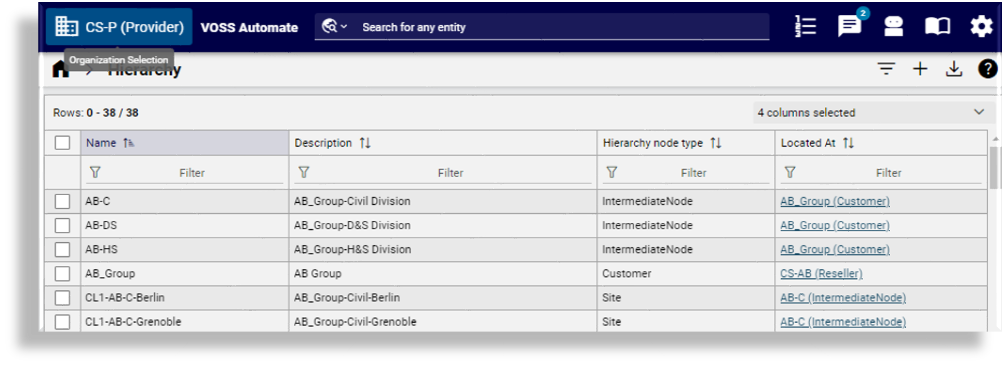
../../_images/hierarchy-org-selection.png

Hierarchy tree view#

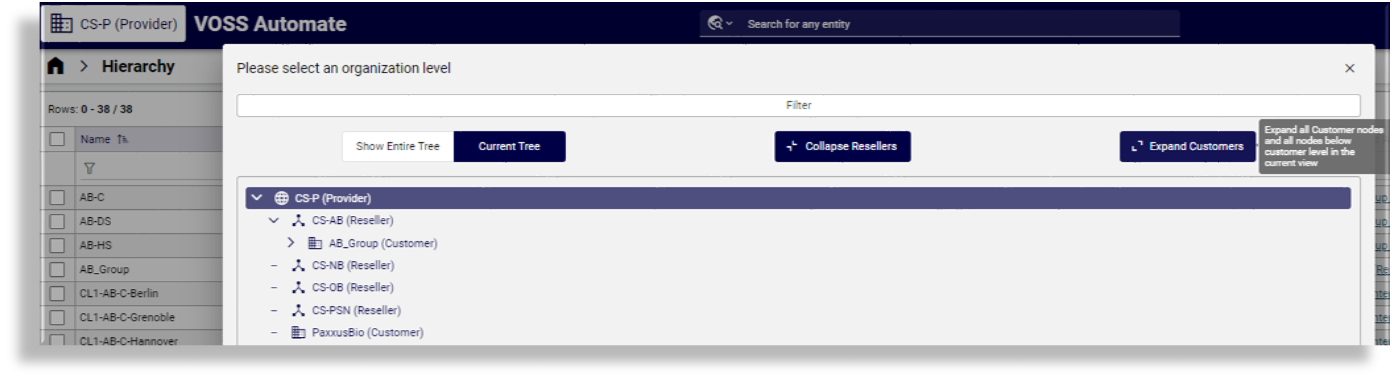
To open a tree view of the entire hierarchy, click the toolbar Organization Selection button.

Nodes in the hierarchy tree are sorted alphabetically, and are displayed with their hierarchy type, either Provider, Reseller, Customer, or Site.

When opening the tree view, the initial state reflects the currently selected hierarchy, including its sibling and child nodes, with any intermediate and site nodes for that hierarchy expanded, allowing you to easily switch to a different site.

In the hierarchy tree view:

  • Choose a hierarchy node to set the system hierarchy to that node

  • Click Entire Tree to expand all hierarchy nodes in the tree

  • Click Current Tree to expand the currently selected hierarchy node.

  • Click Expand Customers to also expand intermediate nodes and site nodes within each customer in the tree

  • The Expand Resellers button changes to Expand Providers if the hierarchy tree contains no Reseller nodes
../../_images/hierarchy-tree.png

Switching to a different site#

When you’re working on a task at a specific site and want to switch to a different site, clicking the Organization Selection button opens the tree view with the list of sites expanded for the currently selected customer, allowing you to choose another site for the feature you’re working with without having to go back to the previous level in the hierarchy.

Hierarchy list view links#

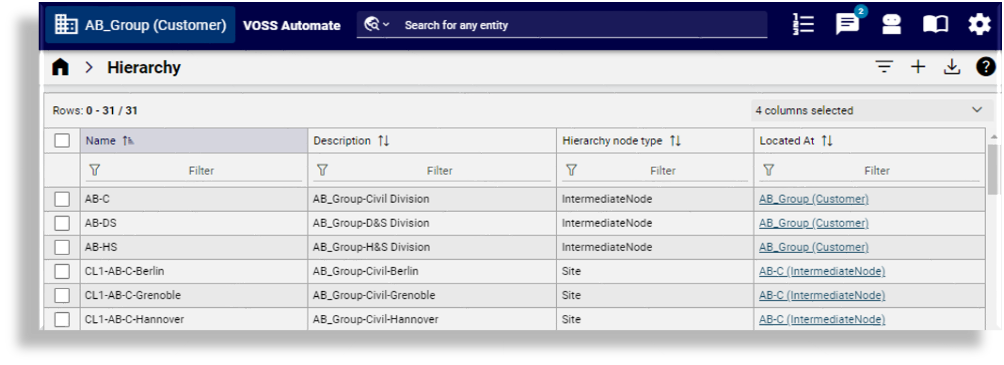
For list views, the Located At column indicates the hierarchy level to which an object belongs.

The hierarchy level name and type shows as the column hierarchy link, for example Overton (Customer).

All the entries in the list that the logged in user’s hierarchy rules allows for, will show as hyperlinks. This also applies to list views of search results. Clicking on the hierarchy link sets the hierarchy to the selected hierarchy in the breadcrumb, and filters items in the list view for that hierarchy.
located-at-column

Note

In the event that another admin user, working on another browser, deletes a hierarchy, for example, a customer or site, the hierarchy bar refreshes once you refresh the browser.

previous

Introduction to Hierarchies

next

View the Hierarchy

  On this page
  • Overview
  • Hierarchy tree view
  • Switching to a different site
  • Hierarchy list view links

By VOSS Solutions

© Copyright 2024, VISIONOSS LIMITED.